Umpire's call applies when DRS ball-tracking shows a delivery clipping the stumps, or striking the pad marginally in line, but the centre of the ball falls outside the relevant zone. The technology is not conclusive enough to overturn, so the on-field decision stands and the reviewing team keeps its review.
Key takeaways
- Umpire's call turns on one test: whether the centre of the ball is inside the zone, not whether any part of the ball touches it.
- It is available on only two of the three LBW checks. Where the ball pitched has no margin at all, because pitching is filmed rather than predicted.
- An LBW review left unchanged solely on umpire's call is logged separately and does not count against a team's allowance.
- As at 9 September 2026 the men’s playing conditions allow three unsuccessful reviews per innings in Tests and two in ODIs and T20Is.
- The margin is one ball radius, about 3.6 cm, derived from the Laws' 22.4–22.9 cm ball circumference.
Every cricket crowd has had this argument. Ball-tracking shows the delivery clipping leg stump, the graphic returns UMPIRE'S CALL, and the batter survives. An hour later a ball that looked no different goes the other way and the batter walks off. Nothing has malfunctioned, and nobody has been favoured. The system did precisely what it is written to do.
Umpire's call is not a hedge, and it is not the third umpire's opinion. It is a fixed geometric margin, set out in the ICC playing conditions, and it settles a marginal review before anyone in the ground has had time to form a view.
What does umpire's call actually mean?
When a team reviews an LBW decision, the ball-tracking technology reports three separate things to the third umpire: where the ball pitched, where it first struck the batter, and whether it would have gone on to hit the stumps.
Umpire's call is available on only two of those three. The playing conditions describe it as the conclusion reported where the technology indicates a marginal decision in respect of either the point of first interception or whether the ball would have hit the stumps.
The test in both cases is the same, and stating it precisely settles most televised arguments on its own: it is the centre of the ball that counts, not the edge of it.
| DRS check | What the technology reports | Umpire's call possible? |
|---|---|---|
| Pitching | In Line, Outside Off, Outside Leg | No |
| Impact | In Line, Umpire's Call, Outside | Yes |
| Wickets | Hitting, Umpire's Call, Missing | Yes |
On the wicket, "Hitting" means the ball was hitting and the centre of the ball was inside the Wicket Zone. "Umpire's Call" means the ball was hitting, but the centre of the ball was not. The ball is shown clipping the stumps in both cases. Only one of them is conclusive.
Why is there no umpire's call for where the ball pitched?
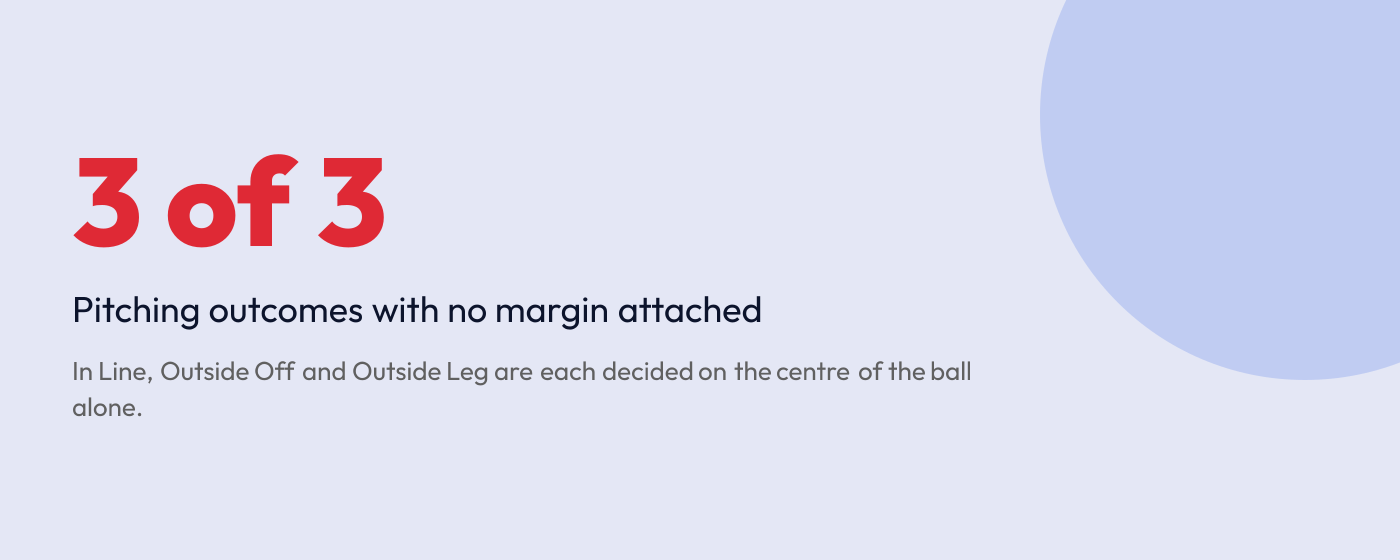
Because pitching is filmed, not predicted. The ball's contact with the surface is a real event that cameras have recorded, so there is no margin of error to protect. The playing conditions give the pitching test three outcomes and no fourth: In Line, Outside Off, or Outside Leg, each decided on where the centre of the ball landed.
That has a consequence readers often get wrong. Pitch it outside leg stump and the batter is not out, however plumb the rest of it looks, and no margin can rescue the appeal.
How wide is the umpire's call margin?
The playing conditions do not publish it as a number, but the geometry gives it up. Umpire's call on the wicket means part of the ball overlaps the zone while its centre sits outside — so the band is exactly one ball radius wide.
The Laws set a men's ball at between 22.4 cm and 22.9 cm in circumference, which is a diameter of roughly 7.1 cm to 7.3 cm. Half of that is about 3.6 cm, a shade under an inch and a half, measured outwards from the edge of the stumps and the top of them.
Set against a wicket 22.86 cm wide and 71.12 cm tall, that band is not generous. It is simply the width of the object everyone is arguing about.
Why can the same ball be out at one end and not out at the other?
This is the part that feels unfair, and it is the deliberate design of the system rather than a flaw in it.
Where a not out decision is reviewed, the technology must report Hitting for the batter to be given out. Umpire's call is not Hitting, so not out stands. Where an out decision is reviewed, the technology must report Missing for the decision to be reversed. Umpire's call is not Missing, so out stands.
One delivery, one ball-tracking output, two opposite results. The variable is not the technology. It is what the umpire said before anyone pressed the button.
That is the principle DRS was built on: the review exists to correct clear errors, not to replace the umpire with a projection. Where the projection is marginal, the person who was standing there keeps the decision.
Does umpire's call cost a team its review?
No, and it has not for some time. An LBW review left unchanged solely on the basis of an umpire's call is logged as "Unchanged – Umpire's Call" and does not count towards the innings limit. The team is no worse off than before it reviewed.
| Outcome of the review | Counts against the limit? |
|---|---|
| On-field decision reversed | No |
| On-field decision unchanged | Yes |
| Unchanged – umpire's call | No |
| Not out stands because it was a no-ball | No |
| Technology failed and the referee reinstates it | No |
The allowances themselves differ by format. As at 9 September 2026, under the men's playing conditions each team may make three unsuccessful Player Reviews per innings in Test cricket, and two in ODIs and T20Is. The scoreboard has to show how many each side has left, and the third umpire tells the on-field umpires once a team has run out.
Why has the ICC kept umpire's call?
It has been asked to remove it more than once. The ICC Cricket Committee examined it in 2021 and left it in place, and its chair, Anil Kumble, set out the reasoning: the principle underpinning DRS was to correct clear errors while preserving the umpire as the decision maker on the field, given the element of prediction the technology involves.
Two adjustments have been made to the margin rather than to the principle:
- 2016 — the impact and stumps zones were widened from the centre of off and leg stump to the outside of them, making the margin narrower and more decisions conclusive.
- 2021 — the height of the Wicket Zone was lifted to the top of the stumps, so the umpire's call margin is now the same above the stumps as it is either side of them. Before that, a ball clipping the top of leg stump was treated differently from one clipping its side.
What is the question a captain is allowed to ask?
One, and only one. Before deciding whether to review an LBW, the fielding captain or the two batters may ask the bowler's end umpire whether the decision was made on the basis that the striker made no genuine attempt to play the ball. Nothing else may be queried, and signals from the dressing room are not permitted.
It matters because that answer changes the geometry. If the batter made a genuine attempt, impact must be In Line for an out. If the umpire judges that no genuine attempt was made, the batter can be given out even when impact was umpire's call on the off side, or outside off stump altogether.
When does ball-tracking not get the last word?
Two situations, both written into the conditions.
The first is distance. If the ball struck the batter 300 cm or more from the stumps, or between 250 cm and 300 cm from them with less than 40 cm between the pitch mark and the point of impact, an on-field not out stands even where the projection shows the ball hitting. There is too little flight after pitching for the prediction to be trusted.
The second is the full toss that would have bounced. Where the ball strikes the batter on the full and the technology indicates it would have pitched before reaching the stumps, no useful height prediction exists. The third umpire may advise only on line and on whether the ball would have hit the stumps, and the height remains the on-field umpire's judgment.
How to watch the next one properly
DRS has been in operation in international cricket since 24 November 2009, when it came into effect for New Zealand v Pakistan at Dunedin and Australia v West Indies at Brisbane after a period of trials. Sixteen years on, the argument in the stands has not changed much, but it is a shorter argument once the margin is understood.
The next time the graphic freezes on a marginal one, read it in this order:
- Which zone is being tested — pitching, impact, or the wicket.
- Whether the centre of the ball is inside that zone, not just some part of it.
- What the on-field umpire had already given, because that is what a marginal result preserves.
That sequence gives the answer every time, usually before the replay has finished.
You can follow reviews as they happen on live scores, check what is on next in the match schedule, and read the day's reporting in the cricket news feed.
Rules as at 9 September 2026, from the ICC men's playing conditions in force for the 2025–27 World Test Championship cycle and the July 2025 ODI and T20I conditions. Playing conditions are revised periodically; check the current documents before relying on a specific clause.
Frequently asked questions
It means the ball-tracking result was marginal. On an LBW review, the ball was shown clipping the stumps or striking the pad in line, but the centre of the ball fell outside the zone being tested. The technology is not conclusive enough to overturn anything, so whatever the on-field umpire originally gave stands.
No. Where an LBW review leaves the on-field decision unchanged solely on the basis of an umpire's call, the ICC playing conditions categorise it as ‘Unchanged – Umpire’s Call’ and it does not count towards the innings limit. The reviewing team keeps the review it just used, which is why sides review marginal appeals at all.
Because the bounce is a recorded event rather than a projection. Cameras have seen exactly where the ball landed, so there is no prediction error to allow for. The conditions give pitching three outcomes only, decided on the centre of the ball: In Line, Outside Off, or Outside Leg. Pitched outside leg is not out, always.
Under the men’s playing conditions as at 9 September 2026, each team may make three unsuccessful Player Reviews per innings in Test cricket and two per innings in ODIs and T20Is. Successful reviews, umpire’s call outcomes and reviews rendered unnecessary by a no-ball do not count against the allowance.
Yes, but only where the bowler’s end umpire judges that no genuine attempt was made to play the ball. In that case the impact may be reported as umpire’s call on the off side, or outside off, and the batter can still be given out. If a genuine attempt was made, impact must be in line.
The ICC Cricket Committee reviewed it in 2021 and kept it. Its chair, Anil Kumble, said DRS was built to correct clear errors while preserving the on-field umpire as the decision maker, given the element of prediction the technology involves. The margin has been narrowed twice instead, in 2016 and 2021.
Sources
- ICC World Test Championship 2025–2027 Playing Conditions, effective June 2025 (Appendix D: DRS)
- ICC Men’s One-Day International Playing Conditions, effective July 2025
- ICC Men’s Twenty20 International Playing Conditions, effective July 2025
- ICC Board and Committee meetings conclude — DRS and third umpire protocol changes (1 April 2021)
- ICC introduces changes to Code of Conduct and DRS Umpire's call
- Ground-breaking decision review system goes into effect tomorrow (23 November 2009)
- Decision Review System — rules and regulations
Statistics in this article were checked as at 9 September 2026.