Net run rate is a team's average runs per over scored across a group, minus the average runs per over scored against it. Only completed matches count, and a side bowled out early is still charged with its full quota of overs. It separates teams that are level on points.
Key takeaways
- Net run rate is runs scored per over across the whole group minus runs conceded per over, calculated once on pooled totals rather than averaged match by match.
- A team bowled out inside its allocation is charged with the full quota of overs it was entitled to, so being dismissed cheaply cannot flatter the figure.
- Matches without a result are excluded entirely, so a team with a washout builds its net run rate from fewer matches than its played column shows.
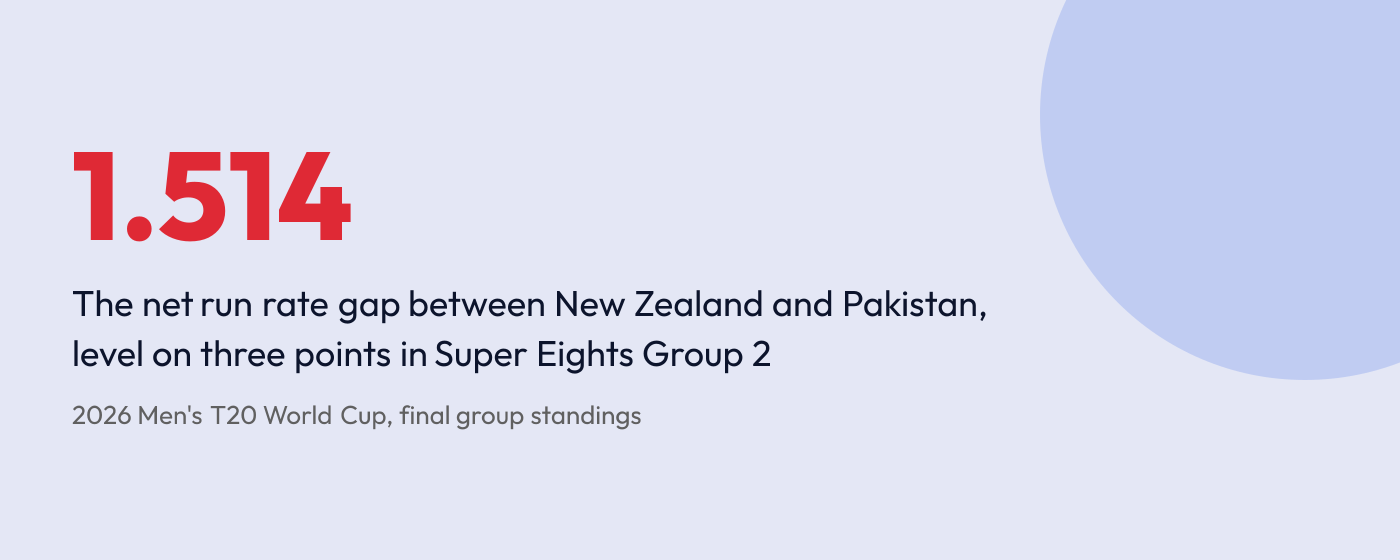
- At the 2026 Men’s T20 World Cup, New Zealand and Pakistan finished Super Eights Group 2 on three points and one win each, and New Zealand advanced on a net run rate of +1.390 to Pakistan’s −0.123.
- Net run rate is only a tie-break: Australia left the same tournament with a higher net run rate than the team that won their group.
Every league stage ends the same way. Two teams finish on the same number of points, one place is left, and a figure carried to three decimals decides which of them flies home. That figure is net run rate.
It is not a mysterious quantity. It is one subtraction, applied across a whole group, with a short set of rules deciding what is allowed into it. Below is the rule as the ICC writes it, then a group where net run rate actually settled a World Cup semi-final place.
What is net run rate, and how is it calculated?
The ICC's definition is short. A team's net run rate is the average runs per over it scores in its group, minus the average runs per over scored against it.
Net run rate = (runs scored ÷ overs faced) − (runs conceded ÷ overs bowled), totalled across every completed match in the group.
Two details do most of the damage when people work it out at home.
The first is that it is a tournament total, not an average of match figures. Runs and overs are pooled across the group and divided once, so a full innings pulls harder on the number than a short one.
The second is that overs are balls, not decimals. An innings of 19.3 overs is nineteen overs and three balls, which is 19.5 overs for the division. Treating it as 19.3 quietly corrupts every figure downstream.
What happens when a team is bowled out early?
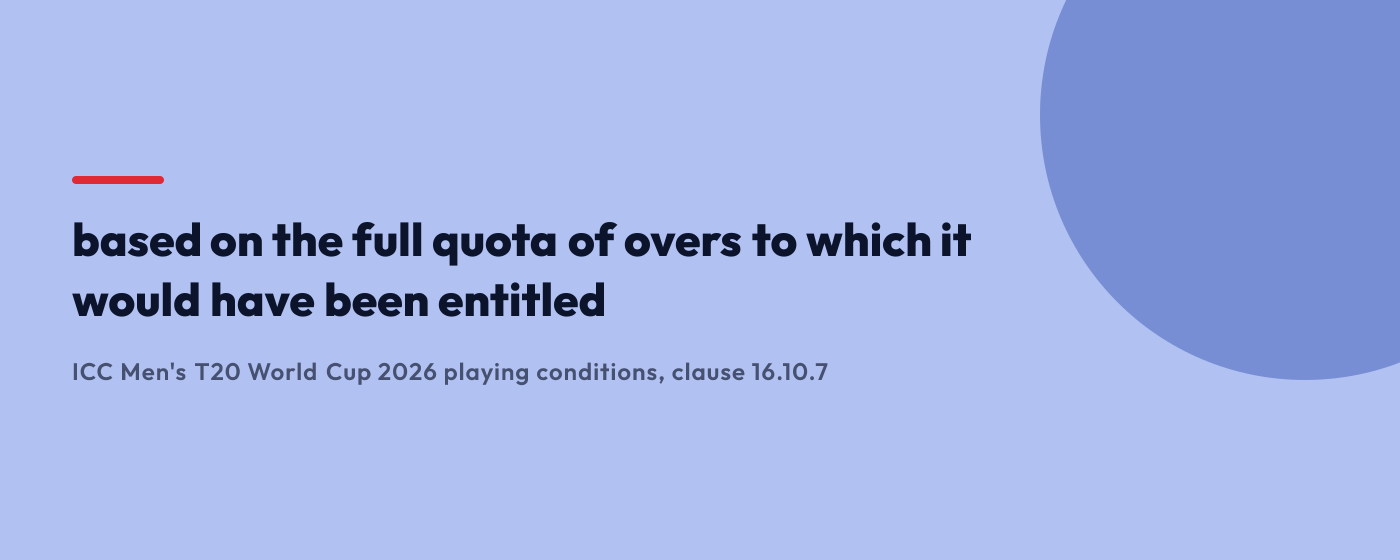
A side dismissed inside its allocation is still charged with the full quota it was entitled to. Clause 16.10.7 of the ICC Men's T20 World Cup 2026 playing conditions puts it directly.
At the 2026 tournament, Oman were bowled out for 104 in 16.2 overs against Australia in Kandy. Their actual run rate in that innings was 6.37. For net run rate, it counted as 104 from 20 overs, a rate of 5.20.
The rule closes an obvious hole. Without it, a team could be dismissed for 60 inside five overs, watch the opposition knock the runs off in ten, and still post the better rate for the match despite losing it. ESPNcricinfo's explainer works that scenario through and lands on minus 3.1 against plus 3.1 once the full quota is applied, which is the order the result deserves.
The rule is one-sided on purpose. A side that is all out is charged the full allocation, while a side that finishes a chase early is credited with only the overs it used.

Which matches count towards it?
Only matches that produce a result. A washout earns a point in the table and contributes nothing at all to net run rate, so a team can play four matches and carry the runs from three.
Zimbabwe's first-round group at the 2026 T20 World Cup shows it on the page. They played four, had one no result, and their net run rate was built from 457 runs in 53 overs against 427 in 60, which is three matches' worth of cricket.
The remaining cases are written into the playing conditions rather than left to the scorers:
- A Super Over is excluded from the calculation entirely.
- Where a match is abandoned but decided by Duckworth-Lewis-Stern, the side batting first is credited with the par score off the overs the chasing side faced.
- Where DLS was applied earlier and the match finished, the side batting first is credited with one run fewer than the final target, off the overs the chasing side was given.
- Where a match is awarded because a team refused to play, the defaulting side is charged with a full 20 overs.
Each of those exists for the same reason: to keep the winning team's net run rate above the losing team's for that match.
How did net run rate decide a semi-final place in 2026?
Super Eights Group 2 at the 2026 Men's T20 World Cup is as clean an example as the format produces. England won all three. Sri Lanka lost all three. New Zealand and Pakistan finished level.
| Team | M | W | L | NR | Pts | Runs for | Runs against | NRR |
|---|---|---|---|---|---|---|---|---|
| England | 3 | 3 | 0 | 0 | 6 | 473 / 58.4 | 418 / 60.0 | +1.096 |
| New Zealand | 3 | 1 | 1 | 1 | 3 | 327 / 40.0 | 268 / 39.3 | +1.390 |
| Pakistan | 3 | 1 | 1 | 1 | 3 | 376 / 40.0 | 373 / 39.1 | −0.123 |
| Sri Lanka | 3 | 0 | 3 | 0 | 0 | 409 / 60.0 | 526 / 60.0 | −1.950 |
Three points each, one win each, one no result each. The New Zealand and Pakistan match, at the R. Premadasa Stadium in Colombo on 21 February 2026, was abandoned without a ball bowled, so a head-to-head result did not exist to be used.
The working behind those two lines is worth following, because it shows where the gap came from rather than simply asserting it.
| Team | Batting | Bowling | Net run rate |
|---|---|---|---|
| New Zealand | 327 from 40.0 overs = 8.175 | 268 from 39.5 overs = 6.785 | +1.390 |
| Pakistan | 376 from 40.0 overs = 9.400 | 373 from 39.167 overs = 9.523 | −0.123 |
New Zealand's runs came from a 61-run win over Sri Lanka and a four-wicket defeat by England. Pakistan's came from a five-run win over Sri Lanka and a two-wicket defeat by England, with England getting home in 19.1 overs.
So Pakistan scored 49 more runs than New Zealand across the group and still finished 1.514 behind, because they also conceded 105 more in barely more than half an over's difference of bowling.
New Zealand, through on the decimals, then beat South Africa by nine wickets in the semi-final in Kolkata and played in the final.
What margin would have changed it?
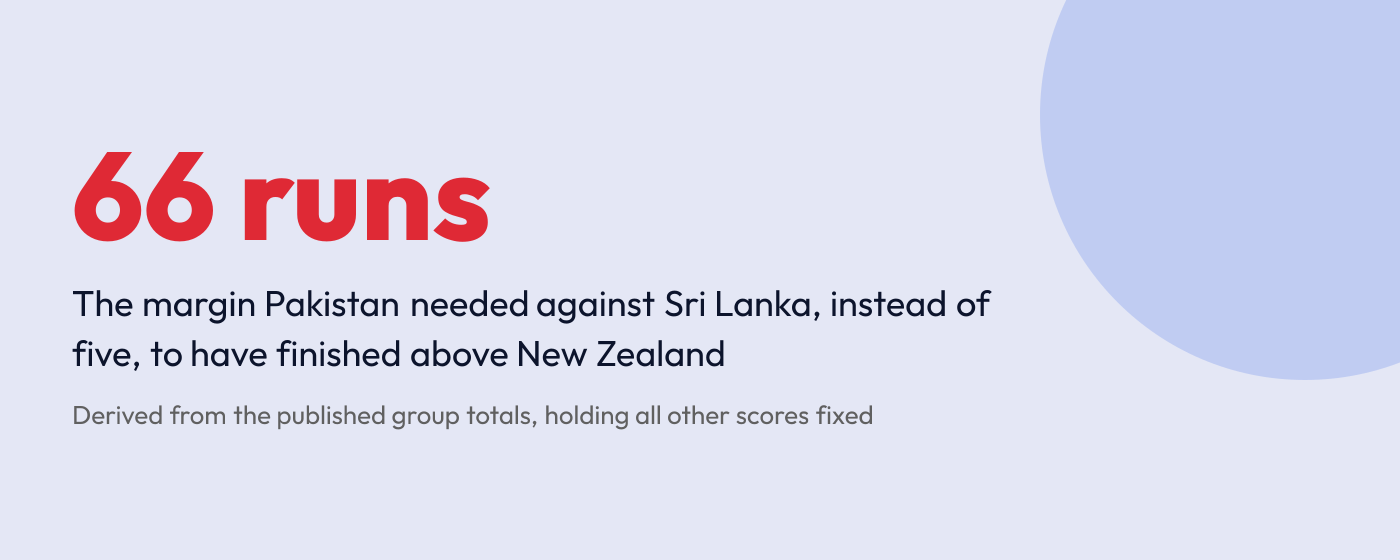
This can be derived from the two lines above rather than asserted. Holding Pakistan's runs conceded and every other score fixed, their batting total across those 40 overs would have needed to reach 437 to edge past New Zealand's +1.390. They made 376.
In practice that means the five-run win over Sri Lanka in Kandy needed to be a win by roughly 66 runs. Same two points, same win column, different margin, different team in the semi-final.
Why can a team with a better net run rate still miss out?
Because net run rate never outranks points. It is a tie-break, not a currency.
The same tournament's first-round Group B makes the point plainly.
| Team | Pts | NRR | Outcome |
|---|---|---|---|
| Zimbabwe | 7 | +1.506 | Progressed |
| Sri Lanka | 6 | +1.741 | Progressed |
| Australia | 4 | +1.523 | Eliminated |
| Ireland | 3 | +0.150 | Eliminated |
| Oman | 0 | −4.845 | Eliminated |
Australia finished with a higher net run rate than the side that topped the group and went out anyway, four points adrift. Sri Lanka had the best net run rate in the group and finished second. In Super Eights Group 1, West Indies carried +0.993 to India's +0.106 and still finished below them, because India had two wins to West Indies' one.

Where does net run rate sit in the tie-break order?
This is the part most readers get wrong, and it is worth checking tournament by tournament, because the order is set by each event's playing conditions and it has moved.
The 2026 Men's T20 World Cup ordered level teams like this:
- Most wins in the group.
- Higher net run rate.
- The head-to-head result between them.
- Position on the ICC Men's T20I Team Rankings as at 6 February 2026.
The ICC's published explanation of the clause used at the 2003 World Cup ran in a different order: wins, then the head-to-head result, then net run rate, then wickets taken per balls bowled, then drawing lots. Under that order, two sides level on points and wins who had already played each other would have been separated by that result, and net run rate would never have been reached.
So the honest answer to whether head-to-head beats net run rate is that it depends on the tournament, and the playing conditions are the only place to settle it. Current ICC team standings sit on the ICC rankings page, and group tables for whichever tournament is running are on the series and tournaments page.
What does net run rate fail to measure?
Wickets. The calculation sees runs and balls, and nothing else.
ESPNcricinfo's explainer points to a one-day international in which New Zealand dismissed Australia for 151 in 32.2 overs and chased the target in 23.1, losing nine wickets on the way. One ball from defeat, they still gained 3.54 on their net run rate for that match, because the arithmetic only saw 152 runs at 6.56 an over against 151 conceded at 3.02.
The blind spot runs both ways: a side that loses a 20-over match by two runs with wickets in hand is barely marked down, while a side bowled out cheaply is charged its full allocation. One suggested repair, noted in that explainer, is to convert every win into a run margin using the DLS par score, since DLS already accounts for both balls remaining and wickets in hand. No ICC event has adopted it.
How should you read a points table during a tournament?
Five habits cover almost everything:
- Read points first, then wins, then net run rate. A gap of one win is worth more than any plausible swing in the decimals.
- Count the matches that actually produced results. A team with a washout has one fewer match in its figures than the "played" column suggests.
- Watch the margins, not just the wins. Every completed match banks runs and overs into a total that cannot be rewritten later.
- Remember that a short chase moves the number hardest. Passing a small target in seven overs shifts a net run rate far more than grinding out a win in the nineteenth.
- Check where net run rate sits in that tournament's tie-break order before assuming a head-to-head result protects anyone.
Group tables, fixtures and ball-by-ball updates for the cricket on right now are on the live scores page. The rules and figures above were checked on 21 September 2026.
Frequently asked questions
Add up every run a team has scored in the group and divide by the overs it faced, then do the same for the runs and overs against it, and subtract the second figure from the first. The totals are pooled across all completed matches and divided once, not averaged across individual games.
The innings is treated as though the side batted its full allocation. Oman were dismissed for 104 in 16.2 overs against Australia at the 2026 T20 World Cup, an actual rate of 6.37, but net run rate counted it as 104 from 20 overs, a rate of 5.20. Without that rule, losing quickly could improve the number.
No. Only matches where a result is achieved count towards the calculation, so an abandoned game adds a point to the table and nothing to the runs or overs. Zimbabwe played four first-round matches at the 2026 T20 World Cup and their net run rate was built from three of them.
Yes, and it is common. Points come first, then wins, and net run rate is only consulted when teams are level on both. Australia went out of the 2026 T20 World Cup first round on four points with a net run rate of +1.523, below Zimbabwe, who topped the group on seven points with +1.506.
It depends on the tournament. The 2026 Men’s T20 World Cup playing conditions placed net run rate above the head-to-head result, while the ICC explanation of the clause used at the 2003 World Cup placed the head-to-head result first. The event playing conditions are the only reliable answer.
No. The calculation only reads runs and balls, so a one-wicket win and a nine-wicket win with the same overs used are worth exactly the same. One suggested fix is to convert results into run margins using DLS par scores, which account for wickets in hand, but no ICC event uses it.
Sources
- ICC Men's T20 World Cup 2026 playing conditions (clauses 16.10.3 to 16.10.7)
- Official explanation of which teams progress in the event of more than two sides being level on points
- ICC Men's T20 World Cup Table 2026
- Explainer: What is net run rate, and how exactly do you go about improving it?
- 2026 Men's T20 World Cup: match scorecards and results
Statistics in this article were checked as at 21 September 2026.